
Results that matter - momentum in 90 days, compounding over 6–12 months.
For founder-led beauty, skincare, supplements, and eCommerce brands who want growth without chaos: we remove the constraint, install operating rhythm, and build systems your team can actually run.
Operator-led: practical execution, not theory decks
Systems-first: clarity, accountability, automation, measurement
Built for scale: foundations that keep working as you grow
Not ready for 1:1? Explore the Scale Foundations Cohort
Benchmarks + realistic “good” outcomes (examples, not promises)
Every brand starts from a different baseline. So instead of throwing random numbers around,
we focus on what matters: fixing the constraint, shipping the work, and tracking progress weekly so momentum compounds.
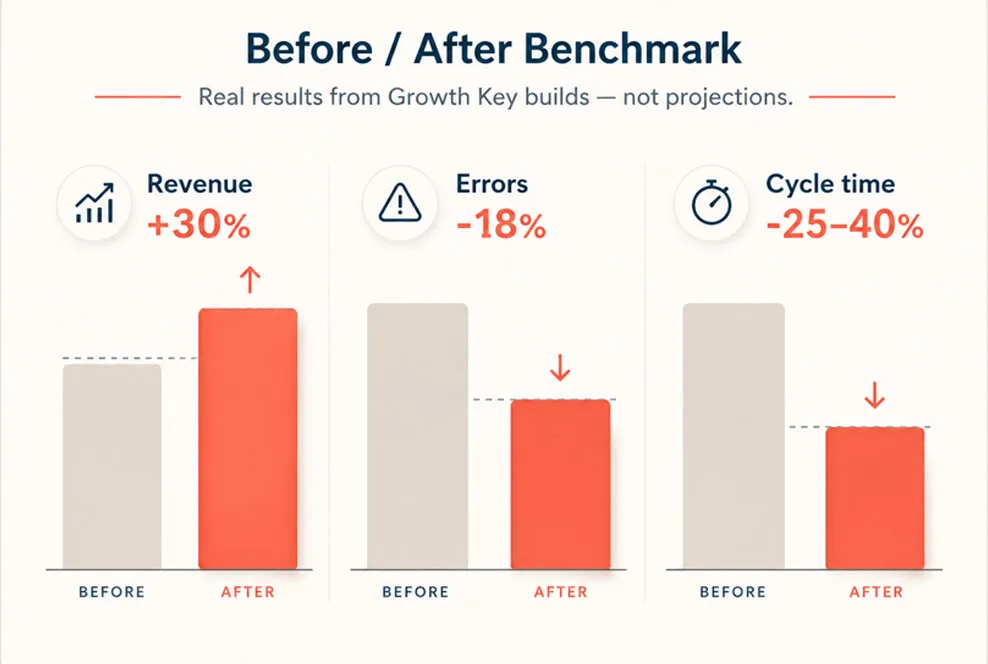
Revenue Up
+30% in 90 days
Typically driven by: tightening the funnel, improving lifecycle fundamentals, and focusing execution on the real constraint.
Errors Down
-18% after ops discipline + automation
Typically driven by: SOPs that stick, fewer handoffs, clear ownership, and quality checkpoints.
Cycle Time Down
25-40% from “idea → live”
Typically driven by: operating rhythm, prioritisation, and removing bottlenecks so work ships faster.
How to read these results
In ~90 days, the goal is repeatable momentum not a one-off win.
What we track weekly:
Commercial: conversion, repeat purchase, contribution margin, CAC payback (as relevant)
Operational: error rate, SLA adherence, rework, cycle time
Execution: owners, scorecard, decisions made, work shipped
Four case highlights
Case 1 — Plateau Reset (Supplement brand, eComm + retail)
Situation: Strong product and proven demand — but growth stalled. Marketing activity stayed high, yet results weren’t compounding. The founder carried too much decision load, and priorities shifted week to week.
What we did
Diagnosed the real constraint (not the loudest symptom)
Built a focused 90-day plan: what matters / what gets ignored
Installed a weekly scorecard and operating rhythm
Shipped the highest-impact fixes across funnel + lifecycle (as relevant)
Clarified ownership and decision rights so execution didn’t bottleneck
What changed
Execution became consistent. The team stopped thrashing. Momentum started compounding because the business was finally attacking the constraint.
Case 2 — Lifecycle Rebuild (Skincare brand)
Situation: Email existed, but it wasn’t a system — it was campaigns and inconsistency. Reporting didn’t clearly show what was driving revenue. Retention was under-leveraged and growth leaned too heavily on acquisition pressure.
What we did
Rebuilt lifecycle flows (welcome, abandon, post-purchase, winback)
Implemented segmentation and list hygiene
Set up reporting that makes lifecycle performance visible
Created a sustainable weekly rhythm the team could run
What changed
Retention became a system — not a scramble. Performance became clearer, more predictable, and less dependent on constant acquisition spend.
Case 3 — Founder Bottleneck (Typical eCommerce startup pattern)
Situation: The business had traction, but execution was fragile. Decisions were slow because everything escalated to the founder. The team was capable, yet work didn’t move without constant context, approvals, and firefighting.
What we did
Installed a leadership rhythm and planning cadence
Defined decision rights and escalation rules
Built a scorecard with clear owners and accountability
Simplified how the team prioritised and shipped
What changed
Cycle time dropped. Decisions sped up. The team moved without waiting and the business became less founder-dependent.
Case 4 — Measurement Repair (One source of truth for decisions)
Situation: Dashboards didn’t match platform numbers. Teams argued about data. Decisions slowed because nobody trusted the baseline — and execution suffered because priorities weren’t grounded in reality.
What we did
Defined decision-grade KPIs (one source of truth)
Rebuilt reporting around actions, not vanity metrics
Installed a clean weekly scorecard
Implemented simple checks so the numbers stayed reliable
What changed
Decision speed increased. Priorities became clearer. Execution improved because the team stopped debating the numbers and started acting on them.
Proof from founders and operators
Here are a few words from the people we’ve worked alongside
Plus quick before/after snapshots of what changed over the engagement.
How we create momentum in 90 days
1
Phase 1 — Diagnose the constraint (Weeks 1–2)
We map what’s actually limiting growth: funnel friction, retention, ops capacity, reporting, or founder bottleneck.
2
Phase 2 — Choose the few moves that matter (Weeks 2–3)
You get a clear plan: what we’ll ship, what we’ll measure, who owns what, and what we’ll ignore for now.
3
Phase 3 — Ship foundations + implement fast (Weeks 3–10)
Execution, not theory: cadence, scorecards, SOPs, lifecycle, reporting, targeted CRO aligned to the constraint.
4
Phase 4 — Lock it in (Weeks 10–12)
Adoption, handover, training, and a “keep compounding” plan so progress doesn’t evaporate.