
How to Increase Online Sales Without Discounting
The fastest way to increase online sales without discounting is to find the problem the discount is covering up. It is almost always one of three things: your offer, your conversion or your repeat orders. Fix that, then replace price cuts with bundles and value-adds that lift what each customer spends. You sell more and keep your margin.
I've built 11 brands, with A$340M+ in revenue and multiple exits between them. I've seen discounting from both sides: the month a sale rescues you, and the year it costs you.
This is about selling more to the customers and traffic you already have. If you need more traffic or a new channel, start with Channel Strategy 101.
Why do discounts stop working?
Discounts stop working because they don't create demand. They pull forward sales that would have happened anyway, and they teach your best customers to wait for the next one.
In 2018 I helped an anti-ageing skincare brand plan its first flash sale. It was strong in direct response TV (DRTV) and digital, and one of the most promising emerging brands in Australia at the time. But it had grown faster than its cash reserves, and it needed revenue quickly.
The flash sale brought in just under $300K from a fairly small customer base. For a single campaign, that is a strong result.
The trouble started the next month. Against my advice, the team began running sitewide sales of 40% off or more almost every month. Each one brought in less than the one before. Full-price sales dropped away, because customers had learned that the full price was just the number they saw before the real price. Within a year, the brand had faded.
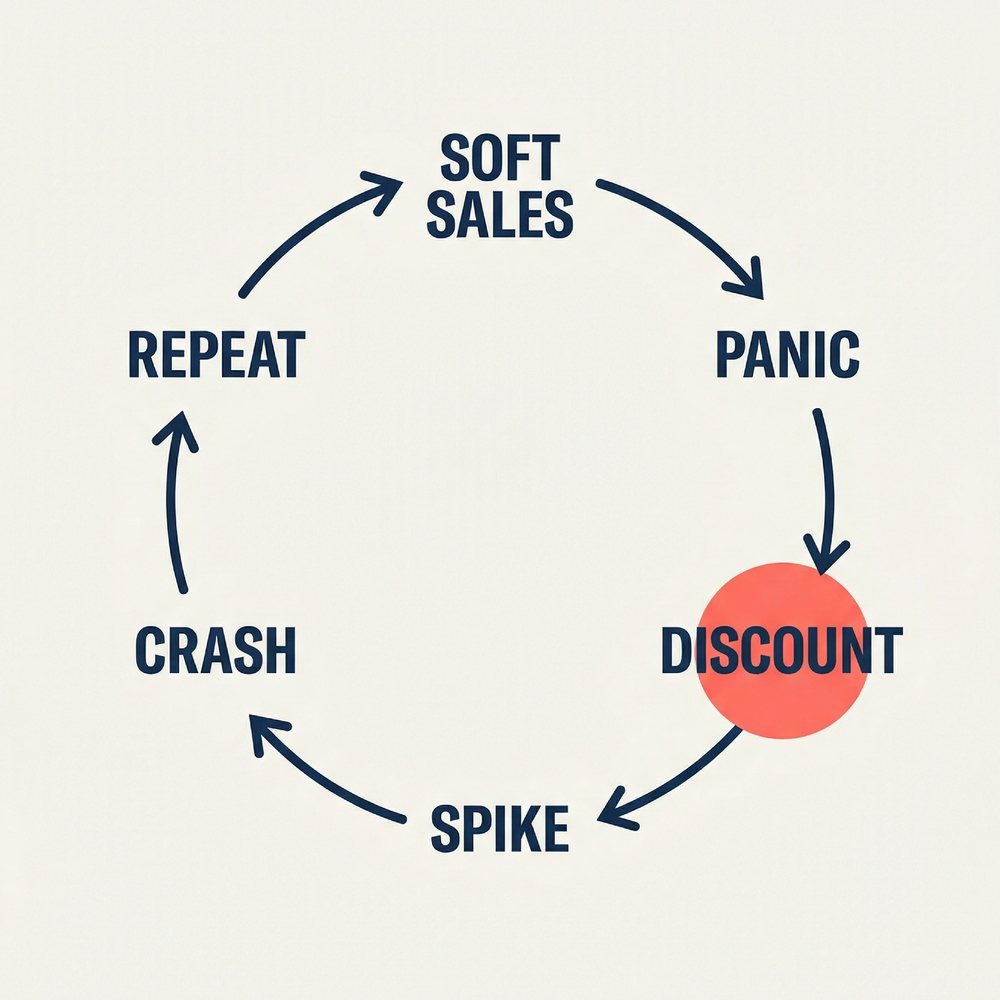
That first sale didn't build the business. It gave the brand a taste of borrowed revenue, and it couldn't stop borrowing. It is the pattern I see most often: margin wears away, customers learn to wait, and the brand needs the next promotion just to stay flat.
Signs your brand depends on promotions
If two or more of these sound familiar, promotions are running your revenue rather than supporting it:
Full-price sales fall away in the month after each promotion.
Each promotion brings in less than the one before.
Promotions drive most of your monthly revenue.
Customers ask you when the next sale is.
Promotional pricing maths: is buy one get one free better than 50% off?
On the same product, buy one get one free (BOGOF) usually leaves you far more margin than 50% off, because the customer still pays full price for one unit. The bigger lesson is to give more, not charge less.
Start with what any discount costs you. The whole discount comes out of your gross profit, so you have to sell more units just to earn what you were already earning. This table shows how many more:
The formula is margin ÷ (margin − discount) − 1. At a 70% gross margin, 30% off means selling 75% more units to make the same gross profit, and that is before you pay for the extra ads. It's worth checking whether your last promotion cleared that bar.
In late 2025, in the run-up to Black Friday, a client asked me on a call: "Is 50% off enough to compete with everyone else out there?" My answer was: "It's a great number if you're racing to the bottom." She had a natural skincare brand with three products and a good upward trend. Anchoring it at half price in its first big sale moment was the last thing it needed.
So we did the maths on the call. Her top product sold for $50 before tax. Its cost of goods (COGS), what each unit cost her to make, was $7. Her blended cost per acquisition (CPA), also called customer acquisition cost (CAC), was about $20. That is what she spent in ads and fees to win one order.
Same product, same customer. One offer makes money on every order. The other loses money on every order. And $20 is a conservative CPA: once you add creative, video, design, merchant fees and platform costs, the real loss on the half-price offer was much bigger.
BOGOF is still a promotion, so it isn't the fix. What the maths shows is the direction to move in. A second unit, a mini or a gift costs you a few dollars of COGS. Half price costs you half your revenue. A free-shipping threshold set just above your average order value works the same way: the customer adds one more item to reach it, and you give away postage, not price. Give more, don't charge less.
For pricing beyond promotions, see Pricing & Positioning.
The 3 online sales bottlenecks a discount hides
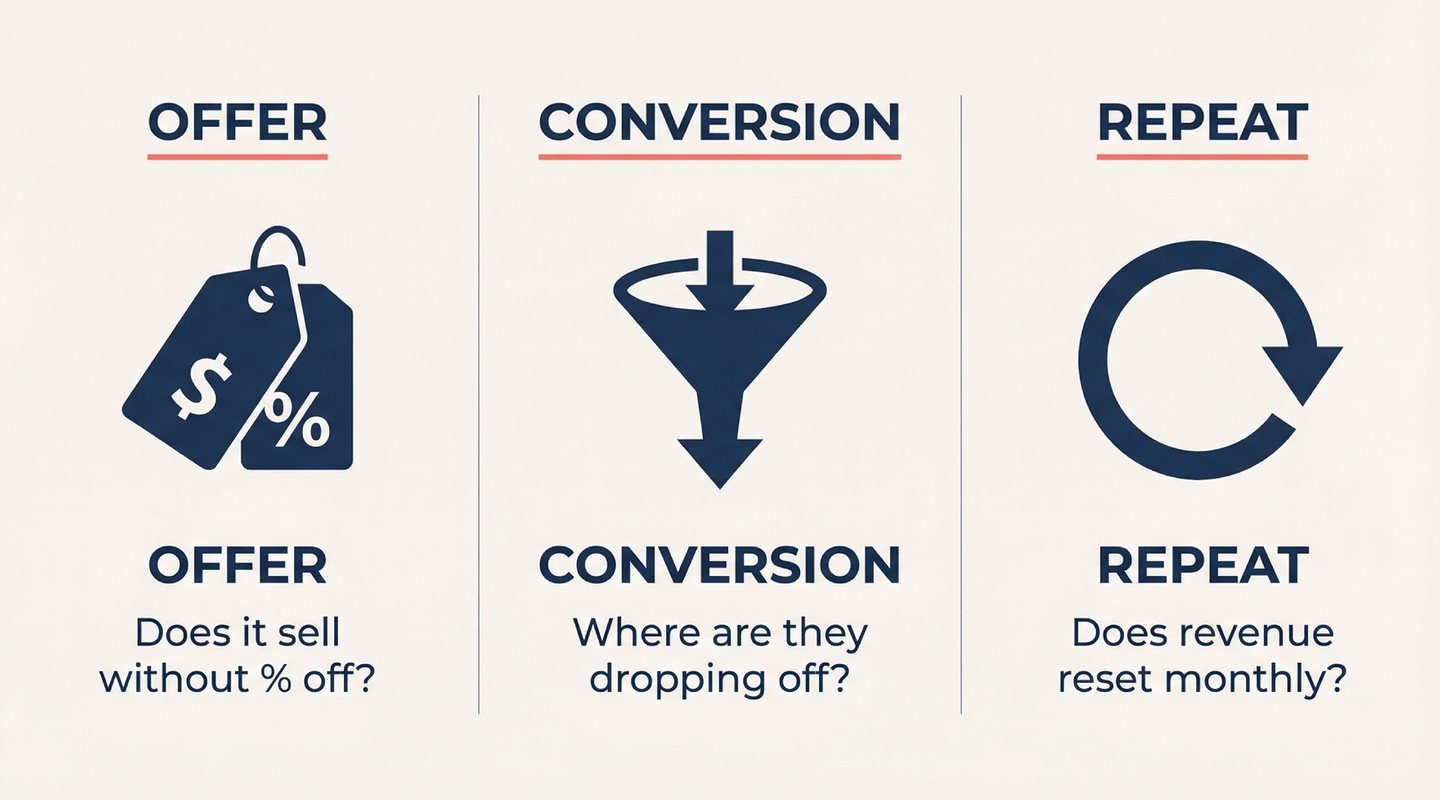
A brand that needs a discount every month has a bottleneck in one of three places. The discount lifts sales on the day, but it hides which one is broken.
Offer: customers can't see why the product is worth full price.
Conversion: shoppers want it, but drop off before they pay.
Repeat: customers buy once and only come back for a sale.
Work out which one you have before you run another sale.
Offer: does your product sell at full price?
If a product only sells with a discount, the problem is usually value, not price. The customer can't see why it is worth paying full price, which means your positioning, the product pages on your online store or your brand story isn't doing its job.
A quick test: can you say why your product is worth full price in ten words or fewer? If you need a paragraph, fix the offer, not the price. Brand Messaging & Storytelling covers how to write it.
Conversion: where do shoppers drop off?
A discount can lift your conversion rate for a week, but it covers up where shoppers are really dropping off. On your online store, the product page, the cart and the checkout each fail for different reasons, and none of them is fixed by 20% off.
One brand I worked with had a 40% add-to-cart rate but only an 8% purchase rate. Plenty of people wanted the product. Something in the checkout was stopping them, and a discount would have hidden that for another quarter.
Repeat: does your revenue reset every month?
If customers only come back when there's a sale on, you aren't building loyalty. You're renting attention.
In my experience, a 10% lift in retention is usually worth about three times as much as a 10% lift in traffic. Yet most brands I see pour their budget into new customers while their repeat purchase rate sits below 15%. Retention is its own discipline, covered in our guide to skincare and supplement retention.
Most beauty and health brands I see are stuck in one of these three places. A discount was never going to fix it. It only hid which one.
What is product bundling, and how does it increase sales without discounting?
Product bundling means selling two or more products together as one offer. For ecommerce brands, it increases sales without discounting because each customer spends more per order, so your acquisition cost is spread over more product and your margin per order holds up.
A bundle is also a planned cross-sell and upsell. The customer buys the next step in their routine at the same time as the first, and trades up to a bigger order, instead of you paying to win them back later.
Bundles aren't free. Every extra unit adds cost of goods, so a bundle doesn't leave your margin untouched. What it does is protect your margin per order, which a percentage discount can't.
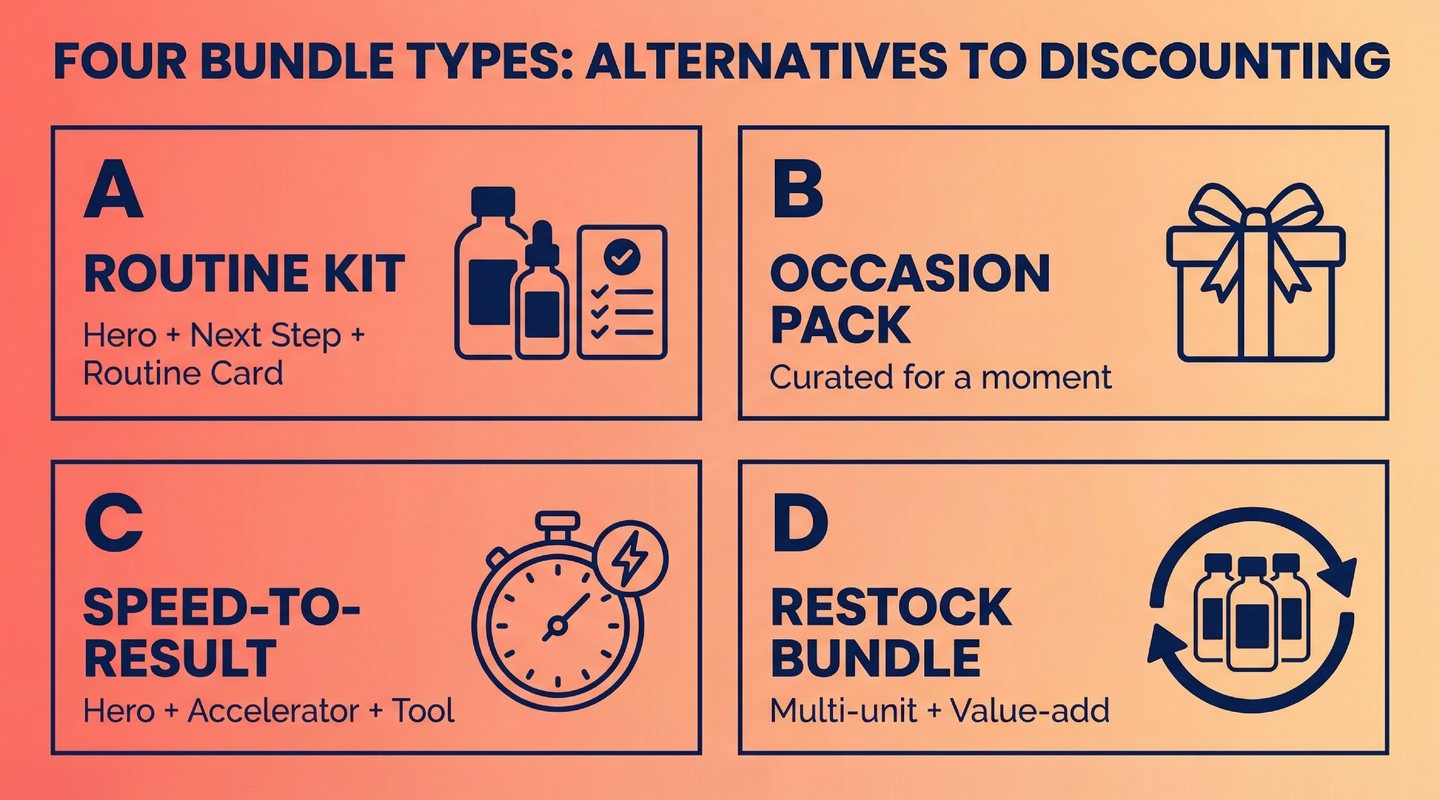
These are the four bundle types I use with clients:
The Routine Kit
A Routine Kit pairs your hero product with the next step in the routine and a simple routine card. Think "AM Essentials" or "Barrier Reset Kit". It sells a system instead of a single product, so customers use more, more often, and reorder sooner. Best for skincare, wellness and supplements.
The Occasion Pack
An Occasion Pack is a set curated for a gift, an event or a season, such as a "Summer Glow Set". The occasion sets the deadline, so you get urgency without a countdown timer or a price cut. Best for cosmetics, fragrance and brands with a lot of gifting sales.
The Speed-to-Result Bundle
A Speed-to-Result Bundle puts the hero product together with an accelerator and a tool or a mini, such as a "7-Day Glow Starter". The customer isn't paying more for the same thing. They're paying for a faster result. Best for acne, anti-ageing and other results-led skincare. Keep the claims on the page within what your products are allowed to say.
The Restock Bundle
A Restock Bundle sells several units with a value-add instead of a discount, for example "3-Month Supply + Priority Restock Access". It locks in the next purchase at full price. Best for consumables and supplements. Subscriptions and reorder reminders belong to retention.
How should you price a product bundle?
Price a bundle from the margin, not from the discount. My approach: set the bundle at, or close to, the full price of the products inside it, and add value the customer can see, such as a routine card, a mini or priority restock, instead of showing a saving.
If you do show a saving on the set, keep it small and check one number before you launch: the margin per order on the bundle has to beat the margin per order on a single unit. If it doesn't, the bundle is a discount in disguise.
Once it is live, track three numbers: average order value (AOV), which is what a customer spends per order; margin per order; and the repeat purchase rate of bundle buyers compared with single-unit buyers.
Case study: from near insolvency to funded and expanding overseas
One beauty brand I worked with went from near insolvency to funded growth by replacing discounts with bundles.
The brand started in colour cosmetics and moved into skincare. It had good products and a few hero products that did well early. But it sold everything online as single units, and when growth stalled it started discounting. By the time we began working together, it was near insolvency.
We built three core bundles it could run hard for at least two months without the creative going stale. We also mirrored its retail offers online, but at different times, so the two channels didn't undercut each other (channel conflict).
Average order value went from $50 to $140, with some bundles selling at $350. The bigger change was in how the team thought. They stopped treating "offer" and "discount" as the same word, and started showing value through bundles and gifts with purchase.
The brand is now funded and expanding overseas. It got there by building offers, not by cutting prices further.
You can see more client results on our Results page.
Should beauty brands do Black Friday?
Only if you lead with an offer that protects your margin, such as an Occasion Pack or a gift with purchase, rather than a sitewide percentage off. The same decision applies to Cyber Monday, Click Frenzy, EOFY and Boxing Day sales.
The reason is the maths above. A percentage off comes straight out of your margin. A gift or a set adds a few dollars of cost and lifts the order.
In Black Friday week everyone is discounting, and a lot of the shoppers are deal hunters who will move on to the next deal. You don't have to win them. Lead with a set for the customers who already want your brand.
Black Friday also rewards brands that have their offers built before the rush. If your bundles and gifts are ready in October, you can take part in the sale period without joining the race to the bottom.
If you do discount, make the saving real. Under Australian Consumer Law, a "was" price must be a price you actually sold at, and the ACCC's guidance on price claims explains what counts as misleading. The rules also cover lifting a price before a sale so the discount looks bigger. The ACCC watches this period closely: in June 2025, three retailers, one of them a hair and beauty retailer, each paid a $19,800 penalty over Black Friday ads that, the ACCC alleged, overstated how much was on sale.
How to move away from discounts without losing revenue
Don't stop discounting overnight. Run bundles alongside your promotions for one quarter, measure the right numbers, and shift the mix step by step.
Run one bundle test beside your next planned promotion.
Measure AOV, margin per order and repeat purchase rate, not just the revenue spike.
Set a target for the quarter. If promotions drive 60% of your monthly revenue now, aim for under 30% within 90 days.
Fill the gap with bundles, gifts with purchase and value-adds, not deeper cuts.
If you keep a discount, keep it targeted: first orders, abandoned carts or lapsed customers, never sitewide. Even a 10% welcome discount is worth testing against a gift, a sample or free shipping.
Review the numbers each month. Keep what lifts margin per order and drop what doesn't.
You'll know it's working when revenue stops resetting to zero after each promotion.
Growth Key helps Australian beauty and health brands design bundles and offers that replace discounts. If you want help finding the bottleneck under your promotions and building the offers to replace them, contact us to request a strategy call.
Frequently asked questions
How can I increase online sales without discounting?
Find the bottleneck first: your offer, your conversion or your repeat orders. Then replace price cuts with bundles, gifts with purchase and value-adds that lift order value. Track average order value, margin per order and repeat purchase rate, so you can see whether the change works beyond a one-day spike.
Is a bundle better than a discount?
Usually, yes. A discount takes money off every order. A bundle raises the order value, so your acquisition cost is spread over more product and your margin per order holds up. Bundles still add cost of goods, so check that a bundle's margin per order beats a single-unit sale.
Is buy one get one free better than 50% off?
On the same product, usually yes. With BOGOF the customer still pays full price for one unit, so you keep the revenue and give a second unit away at cost. With 50% off you lose half the revenue. In one client's numbers, BOGOF left $16 per order and 50% off lost $2.
Do discounts hurt a brand long term?
Frequent discounts train customers to wait for the next sale and wear down full-price sales. The brand ends up needing a promotion just to stay flat. Occasional, planned promotions are fine. The damage starts when the promotion becomes the business model.
What is product bundling?
Product bundling means selling two or more products together as one offer, such as a routine kit or a gift set. Done well, it lifts average order value, gets customers using more of your range and protects margin per order better than a straight discount.
What if I only have one product to bundle?
Sell more of it, or add value around it. A multi-unit Restock Bundle, a travel-size mini, a tool or a routine card all lift order value without a second product. A gift with purchase works too.
What should you track to measure bundle performance?
Track average order value, margin per order, and the repeat purchase rate of bundle buyers against single-unit buyers. Also watch the share of monthly revenue that comes from promotions. If bundles are working, that share falls while margin per order holds or rises.
How do you run a promotion without hurting your margin?
Give more instead of charging less. A gift with purchase, a mini, a set or a value-add like priority restock costs a few dollars of cost of goods. A percentage off comes straight out of revenue. Work out margin per order after cost of goods and acquisition cost before you launch.
Should small beauty brands do Black Friday sales?
Only with an offer that protects margin. Lead with an occasion pack or a gift with purchase rather than a sitewide percentage, and have your offers ready before November. If you do discount, make sure any "was" price is real, as Australian Consumer Law requires.